
The European Union has made the fight against smoking one of its top public health priorities, because tobacco accounts for over 650,000 deaths every year in the European Union. This includes 19,000 deaths from passive smoking and these people have never even smoked!
On the 1st March 2005, the European Commission launched a large media campaign “HELP – For a life without tobacco“, which was one of the largest public health awareness-raising initiatives ever organised in the world and it was conducted in all (then) 27 EU countries.
The general motto of the campaign was to provide „Help and support“ - young people (15-34 year-olds) were the main target of the Help campaign because of their attitude that “denormalisation of smoking“ is trendy in Europe.
Few more facts:
• MTV created a TV add and website in 2006 - the purpose was to target young people and so they came up with a catch phrase „Tobacco…where do you stand?“
• Since 2006 there were online campaigns for youth in all European countries and pan-European portals such as Yahoo, MSN or Meetic.
• A powerful viral was launched in October 2007 - a fake online store www.nicomarket.com (7.5 million video views, 450,000 visits).
• A specific Internet website (www.help-eu.com) - active in 22 languages.
• There was a strong and immediate response to the broadcast of Help TV spots as they propelled visits to the www.hrlp-eu.com website: proof that the campaign was effective!
After 4 years of the campaign, the results are impressive:
There is a large media coverage with TV, press, radio and internet releases – to be more specific, there are over 6,800 articles and reports in the media since the beginning of the help campaign.
According to latest enquiry, a one third of Europeans declare to having seen the Help campaign – it is amazing!
Also7 million Internet users for the www.help-eu.com website and more than 1,100 national events performed europe-wide.
340,000 europeans measured their tobacco-related carbon monoxide levels.
4.5 billion media contacts achieved in 4 years (TV + Internet).
59% of young Europeans (under 25) saw at least 1 Help film and 82% of young Europeans liked the advert.
For the conclusion..
I would like to quote Ralph Waldo Emerson: “The believing we do something when we do nothing is the first illusion of tobacco.“ – this is a greate sentence which says that smoking is pointless bad habbit, which kills. I´m glad that The Help Programme was so successful!
Showing posts with label PR campaign. Show all posts
Showing posts with label PR campaign. Show all posts
Friday, May 15, 2009

Wednesday, March 18, 2009
Best PR acts of 2008 selected
Here's a news article from EPRA that I translated into english with my added comments:
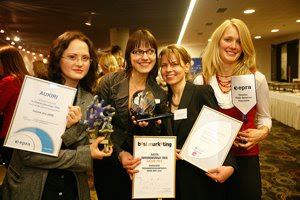
Estonian Public Relations Association (EPRA) jury announced in Tartu at marketing conference Password 2009 the best PR acts of year 2008 that were divided into three categories - public, third and private sectors. As 2008 was the year of innovation, additional prize was given for most innovative PR campaign. In total 13 great works of PR were applied which all were seen as professional and well prepared.

2008 years best public PR act won campaign for celebrating Estonian Republic jubilee which standed out with its aforethought, coverage and project leading.
Symbol they used, the leaf’s that also visualized 90 was catchy and people loved this and many companyes wanted to put this on their products and packages.
Teeme ära 2008 won every possible award

Best PR project in third sector was selected the nationwide cleaning campaign “Teeme ära 2008” (Let’s do it 2008) which was unprecedented and with its communication were able to involve the most volunteers in the history.
The Let’s Do it 2008 PR campaign’s communication were mainly channeled through internet. They used internet community websites like Orkut, Facebook, bkite.com, twitter, flickr, googlemaps, ect.
In private sector were the most applied works and from the tight competition won the Corpore leaded AEG Bocouse pro-chef competition (Ordered by AEG Electrolux), where taking in mind their target group they developed a perfectly working output and message.
For innovation year prize the Loovagentuur Maailm organized the world’s first song festival held in Võru’s local language UMA PIDO. The prize was given for organizing communication for this festival ordered by Võru Institute which brought together over 10 000 people forming the cultural event no.1. Project keyword was acting together and joining the community.
Campaigns were judged by EPRA public relations experts: Mart Soonik, Aive Levandi, Tiiu Allikmäe, Aili Ohlau, Erkki Peetsalu and Janno Toots.
via EPRA
Thursday, March 12, 2009
Unethical PR in the nearby past in Estonia
When trying to recall unethical PR strategies in Estonia I remembered two incidents - Swedbank's (formerly Hansapank) youth campaign for their NPNK products and services; and the demolition of Sakala cultural centre. I'll try to explain both of them in this blog, at first about the NPNK campaign.
 In april, 2005, bigger cities were flooded with rat-signs stating the letters NPNK, they covered all the bus-stops, lightposts, trash-bins and so on. You could find stickers and posters literally everywhere you looked, free t-shirts were distributed in large amounts. At first they stated nothing more than the letters, but a day later a website address appearaed, it was www.zone.ee/npnk, Zone Media provides free web space for everyone that registers. The website claimed to be a website for independent squatters ("Squatting is the act of occupying an abandoned or unoccupied space or building, usually residential, that the squatter does not own, rent or otherwise have permission to use." - http://en.wikipedia.org/wiki/Squatting), and their goal remained unclear, yet squats are usually places for young creative people to get together. The campaign appealed to youth and they became carriers of Swedbanks message, unknowingly.
What caught my eye in the first couple of days was that the space where the posters were glued on the bus stations and trash bins, usually a place for ads, was blank beneath the posters. Also, the supplies handed out and glued all over the city must have cost at least a couple of hundred thousand kroons, where would some independent squatters take that kind of money and what what is their purpose? This smelt an awful lot like a lie. A friend of mine was distributing stickers for NPNK, he was hired by the ad agency Tank. By that time it was ofcourse clear that this is some big corporations viral marketing trick. He wasn't told any information on whats behind it, but he was said that it's okay to stick them on Hansapanks atm-s. When I queried the domain www.npnk.ee, of course it was already registered. And what a suprise, it was registered to a ltd company, whose address was Liivalaia 8... guess which companies headquarter is on the same address? Bingo.
After a week NPNK had gotten a lot of publicity - advertisement for free. They got the front cover of Estonias most read daily newspaper, Postimees covered with their logos for 0 kroons, a place that is not even available to buy for advertising. Of course, as we all know from Principles of PR, publicity is uncontrollable. As it revealed that Hansapank had lied on the campaign and claimed to be someone it's not, youth who had respect for subcultures like squatters got angry. At least one official movement was started to protest against Hansapank. They started a squat in Hansapank and demanded the following things:
1. Hansapank will apologize publicly for taking advantage of the squatters subculture, faking a grass-roots campaign, misleading the public and for betraying the trust and cincere wish to support actions like squatting.
2. Hansapank will give up the brand NPNK and campaigns like this and other unethical advertising strategies in their forthcoming economical activity.
It seemed that Hansapank itself was startled as well that their campaign met such a resistance among the very ones they were supposed to influence to become users of NPNK. Being suprised they did at least a couple of things right - they called the protest movement leaders to a meeting. Of course they did not give up on the brand where they had buried a lot of money. But the protesters at least achieved one of their goals - Hansapank apologized publicly and admitted that the campaign, done like this, was a mistake.
In april, 2005, bigger cities were flooded with rat-signs stating the letters NPNK, they covered all the bus-stops, lightposts, trash-bins and so on. You could find stickers and posters literally everywhere you looked, free t-shirts were distributed in large amounts. At first they stated nothing more than the letters, but a day later a website address appearaed, it was www.zone.ee/npnk, Zone Media provides free web space for everyone that registers. The website claimed to be a website for independent squatters ("Squatting is the act of occupying an abandoned or unoccupied space or building, usually residential, that the squatter does not own, rent or otherwise have permission to use." - http://en.wikipedia.org/wiki/Squatting), and their goal remained unclear, yet squats are usually places for young creative people to get together. The campaign appealed to youth and they became carriers of Swedbanks message, unknowingly.What caught my eye in the first couple of days was that the space where the posters were glued on the bus stations and trash bins, usually a place for ads, was blank beneath the posters. Also, the supplies handed out and glued all over the city must have cost at least a couple of hundred thousand kroons, where would some independent squatters take that kind of money and what what is their purpose? This smelt an awful lot like a lie. A friend of mine was distributing stickers for NPNK, he was hired by the ad agency Tank. By that time it was ofcourse clear that this is some big corporations viral marketing trick. He wasn't told any information on whats behind it, but he was said that it's okay to stick them on Hansapanks atm-s. When I queried the domain www.npnk.ee, of course it was already registered. And what a suprise, it was registered to a ltd company, whose address was Liivalaia 8... guess which companies headquarter is on the same address? Bingo.
After a week NPNK had gotten a lot of publicity - advertisement for free. They got the front cover of Estonias most read daily newspaper, Postimees covered with their logos for 0 kroons, a place that is not even available to buy for advertising. Of course, as we all know from Principles of PR, publicity is uncontrollable. As it revealed that Hansapank had lied on the campaign and claimed to be someone it's not, youth who had respect for subcultures like squatters got angry. At least one official movement was started to protest against Hansapank. They started a squat in Hansapank and demanded the following things:
1. Hansapank will apologize publicly for taking advantage of the squatters subculture, faking a grass-roots campaign, misleading the public and for betraying the trust and cincere wish to support actions like squatting.
2. Hansapank will give up the brand NPNK and campaigns like this and other unethical advertising strategies in their forthcoming economical activity.
It seemed that Hansapank itself was startled as well that their campaign met such a resistance among the very ones they were supposed to influence to become users of NPNK. Being suprised they did at least a couple of things right - they called the protest movement leaders to a meeting. Of course they did not give up on the brand where they had buried a lot of money. But the protesters at least achieved one of their goals - Hansapank apologized publicly and admitted that the campaign, done like this, was a mistake.
Wednesday, March 11, 2009
How to sell batteries
Lately I found myself admiring the success of one specific regular household battery and no, I'm not talking about the forever going rabbit powered by Duracell.
Namely Panasonic has introduced a new battery called EVOLTA (“EVOIA” in Europe) that lasts longer than any other and recognized by Guinness World Record as the world’s “longest lasting AA alkaline battery cell”
My first sightings about this battery evolution were in technology blog called Engadget in somewhere at the end of last year. The news itself is more than a year old. The first thoughts were that why there is a news article written about a regular battery?
Lately I noticed a package of those batteries in a store near my home village. The package design and the world EVOIA caught my eye and I recognized them: “Oh hey, aren’t those the batteries said to be world’s best?”

I thought how well did it succeeded as a PR campaign for this simple everyday item.
Let’s imagine that you are at the beginning of the process of bring the new battery to the market. Currently in the lead is the well known Duracell with their rock climbing bunny and right after that seems to be the Energizer with the similar pink drum banging bunny. So what to do with those market leading rabbits?
Well the Panasonic got somehow the Guinness World Record for their innovative battery that outlasts the competitors by 20-30%. What a good chance to but a well known and trusted Guinness World Record logo onto the package making the batteries look professional and not comparing the performance by how high can a cute stuffed rabbit clime on the cliffs.
So why did I chose that brand of batteries? Look at it this way: if you are at shop choosing between different products, what are the main things you decide on when buying a regular battery? For me it’s how long they last as simply there is nothing other to compare. So if Panasonic has this flashy yellow sticker on the package stating: “World’s No. 1 Long Lasting” and they have Guinness World Record to stand behind that statement then for me it’s a sale! If you ask that is the 20-30% longer lifetime also expensive, then 3-5% difference in price is still worth it. You then don’t have to change the batteries so often and by that you also keep the world a greener place as you use fewer batteries.
In my opinion, the EVOIA has a good chance on becoming the market leader in a few years or so.
Subscribe to:
Posts (Atom)

